Posted on 4 Comments

The Forced Approach and Landing

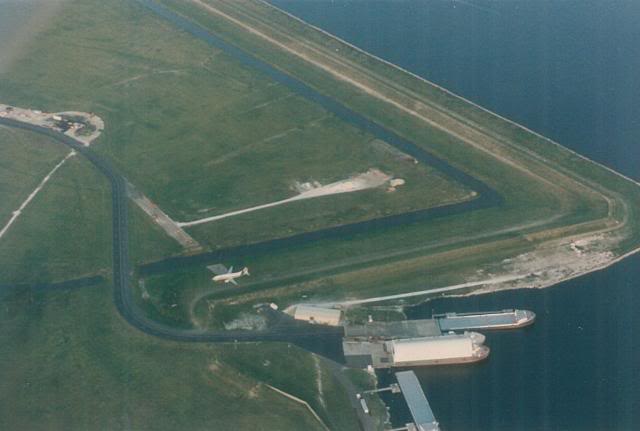
Forced Landing of TACA Airlines Flight 110. Image Courtesy of airliners.net

So now that we know about the precautionary procedure, what happens if we have NO engine power?

We plan a forced landing! The image above shows an actual forced landing of a Boeing 737 jet. TACA Airlines Flight 110 lost power in both engines and successfully glided and landed on an unprepared, makeshift field (image courtesy of airliners.net).

Is planning a forced landing possible?

For those who believe that a successful forced landing is difficult or impossible to achieve, Transport Canada’s “Flight Training Manual” (FTM) reminds us that for glider pilots every landing must be a successful forced landing. Hence, it is not only possible that it can be done, it can be done well.

Yesterday I went through the basics again with my instructor.  Each instructor has a different way of teaching, so the method will vary slightly for everyone.  The basics are more or less the same.

Famous Forced Landing: The ditching of US Airways Flight 1549 into the Hudson River. Image Source: wikipedia.org
Famous Forced Landing: The ditching of US Airways Flight 1549 into the Hudson River. Image Courtesy of wikipedia.org.

The most successful recent emergency forced landing was US Airways flight 1549: a ditching in the Hudson River. After multiple bird strikes into the engines caused dual engine flameout,  the gliding Airbus A320, which didn’t have enough altitude to return to the airport, was successfully ditched in the Hudson River. Like all pilots, trained in forced approaches, he captain used the same line of thinking that we are taught when learning how to execute a forced approach and landing.

We are flying along – and – we’ve lost engine power! What is the first thing we do? We fly the plane.

(1) Best Glide Speed

We have to establish our aircraft in “best glide speed.”  For the Cessna 172, this is 65 knots. The best glide speed provides the maximum “lift to drag” ratio and allows the airplane to glide as as long as possible.

(2) Best Field

Now we have to look outside and quickly locate the best field where we will put our aircraft.  We locate this field, and turn towards it.  Look for indicators of wind direction on the ground, and make your best efforts to land into the wind. If in doubt of wind direction, simply plan to land in the same direction that you took off from the airport.

Make sure to do a good check of the suitability of the area for landing. This means: check for civilization, obstacles, wind, field length, and landing surface – abbreviated the COWLS check.

(3) Fault

Now that we have our field chosen and have established our glide, we have some time to do some quick engine checks to try to determine the cause of engine failure. Often, with carburetor equipped aircraft such as the Cessna 172 the engine can die due to carb icing.  Or if we descend from a higher altitude and we fail to richen the mixture. These quit simple steps will attempt to reestablish engine power and will not cause us to loose too much time and altitude.

Fuel Selector Valve: Both

Mixture: Full Rich

Carb Heat: On

Ignition: Both

If it doesn’t start, we simply shutdown the engine using the same steps as above:

Fuel Selector Valve: Off

Mixture: Idle cut off

Carb Heat: Off

Ignition: Off.

The above three steps should take us about 500′ of elevation loss to do. Since this is a simulation … we do an engine warm up by adding 200 or so RPM.

(4) Mayday Call

Before we get too low we make the Mayday call. We say “Mayday” three times and our aircraft identifier three times (just like in the case of a precautionary landing).  Broadcast your location, your intentions of where you plan to put the aircraft, the nature of your emergency, and the number of people aboard.

(5) Passenger Brief

Let your passengers know: to put their seat back, stay clear of flight controls, put away all sharp objects, and so on.  You can let them know where the ELT and fire extinguisher are.  Also, it is important to ask them to unlatch the door prior to touchdown.

If this landing is on an unprepared surface, your landing will be a soft field landing.

Make sure to assess how the prevailing winds will affect your approach and landing. What are the upper winds doing?  Also state that you intend to touch down on the first third of the field.  For the Cessna 172, we touch down slightly tail low and turn off the electrical as instructed in the POH.

Successful Forced landings

Another example of a very successful forced approach is in the case of Taca Airlines Flight 110 on May 24, 1988. After flying through severe thunderstorms, the jet lost both engines that the pilots were not able to restart.  In the perfect moment the captain found a grass field and pointed the giant gliding 737 towards it. He was able to land successfully with no loss of life and minimal aircraft damage. In fact, Boeing engineers were able to do the necessary repair work on the spot and the aircraft was flown from the very spot where it was landed! Watch the video of the incident below.

http://www.dailymotion.com/video/x18y15x_mayday-air-crash-investigation-s11e11-nowhere-to-land_shortfilms

Read details of how to plan your approach and land in your desired touchdown spot. This is the low key / high key planning procedure.
Posted on

Precautionary Landings

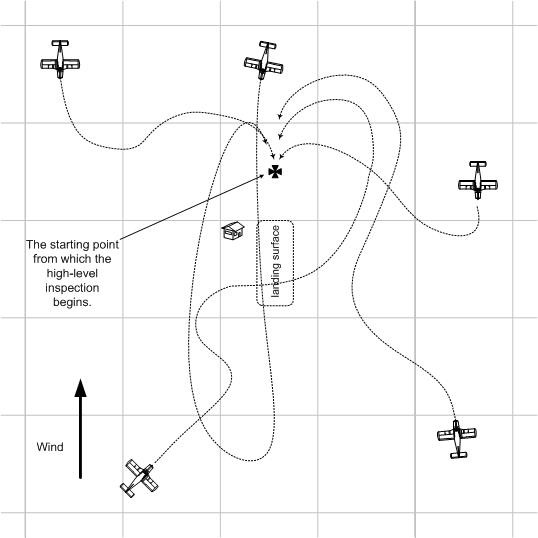
Starting Point for Precautionary Landing. Image Courtesy of Langley Flying School.

Preparing for a precautionary landing

My next series of flights gets me out of the circuit and back into the practice area where I am learning how to do a precautionary landing.

Why do we need to learn this?

There are a number of reasons.  You may have a sick passenger on board, the weather may be a cause of concern.   There may be something that you are concerned with, such as an engine that is acting up, you may be getting low on fuel and think you may not make it much further. In any case, the landing is done to avoid a potentially worsening situation and is done so while engine power is available.  The sooner the landing area is selected the better once a precautionary landing has been decided.  Quite simply, a precautionary landing is completed in two basic steps:

1)  A low pass flown like a circuit over the potential landing area, this is done to inspect the surface for suitability, and

2) A normal circuit flown to end in a safe landing.

There are two basic procedures, one for a controlled airport and one for an uncontrolled airport. In the case where a field is selected, this is obviously uncontrolled.  This is what I have been practicing on.  When we arrive at the practice area, which is the Cremona area just north of Springbank,  we broadcast our intentions for the exercise then proceed to look for a field we can “land” on.

Starting Point for Precautionary Landing. Image Courtesy of Langley Flying School.

We find a field and enter a normal circuit approach. The goal is to make two passes: a high pass and a low pass to judge the suitability of the field for landing.

In an uncontrolled field, such as a farmer’s field, we make a high pass at 1000′ AGL and in a controlled field like an aerodrome we do this at 1500′.   Our high pass is done at cruise settings, 90 knots in the 172.  We fly the normal circuit at 1000′ and then overshoot.

Then we do the “3 Ps“:

(1) Pan Pan call: alert traffic in the area that we are preparing for a precautionary landing.  We say “Pan Pan” three times and say our aircraft identifier (for example, FIAH, GSKF, and so on) three times.

(2) Passenger brief. Let your passengers know what you will be doing, to stay calm, to put their hands free of the controls, and to move their seat back (if sitting in the front).  Then:

(3) We do our Pre-landing checks.

Then we do the low pass. This is done 500′ AGL or whatever altitude is best for inspecting the landing area. In the 172, we fly at 60 knots with 20 degree flap.   The slower speed will allow for better inspection of the field, and the flaps will allow for better forward visibility. The speed is also not too slow – that is it’s not in the slow flight range – which will allow the pilot to focus on observing the field rather than maneuvering the airplane. We also want to prevent getting close to a stall.

Precautionary Landing Procedure. Image Courtesy of mpaviation.com

On our observation of the field, we want to do our “COWLS” check, for suitability in landing:

C = Civilization: are there homes, buildings, or people nearby?

O = Obstacles: are there any obstacles that need to be cleared, such as powerlines, or trees?

W = Wind: always try to land into the wind if possible. Look for indicators on the ground: direction of smoke, direction of long grass, trees, etc.  Is smoke trailing upwards (calm winds), being blown slightly (gentle winds) or rapidly breaking off (strong winds)?

L = Length: once we are abeam the threshold, we count how many seconds it takes us to fly the length of the field. This is why we use 60 knots at 20 degree flap in the 172: if we count the seconds it takes to fly that length, we can estimate the approximate length of the field.

On the low pass, 500′ AGL, abeam the threshold, we start the timer. If it’s 20 seconds, the length is 2000′, (20 * 100); if it takes 33 seconds, the length is 3300′, (33 * 100)  and so on.

S = Surface: Check the suitability of the surface for landing. For example, are there ruts in the ground, or is the surface smooth? Is the surface grass or dirt?

Once our high and low passes are completed, we establish for a normal approach with full flaps.

Next read about the forced approach and see where it actually happened in real life!

Posted on

Slow Flight

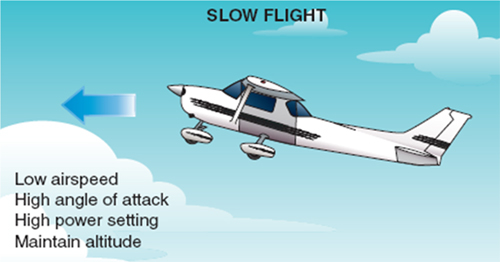
Slow Flight. Image courtesy of gauravteneja.com.

Why do we need to learn slow flight?

Because we are really close slow flight whenever we are landing and taking off, and we need to know how the airplane “feels” to operate at such low speeds. We don’t want to be in slow flight during these phases, so we want to know how to avoid it.  Also, we pass through slow flight on our way to a stall, so we need to recognize when our airplane is losing enough airspeed and approaching a stall.

To enter slow flight for a Cessna 172:

1)  Complete the HALT check. Each school has it’s own acronym or procedure for this check, but they are basically the same:

H = Height. Must be recovered by 2000′ AGL

A = Area. Not over a built-up, or civilized area. No buildings, homes, people.

L = Landing Checklist

T = Turn Checks. We do a 30 degree angle of bank turn in each direction 90 degrees. This is how we check for traffic in the area.

2)  Reduce RPM to 1500 – Carb Heat Hot. Note the nose will drop.

3)  Maintain altitude and heading. Pull up to prevent the aircraft from descending.

4) Add power to hold altitude.

Confirm Slow Flight. The following are five signs that alert us that we are in slow flight:

1. Stall Horn cutting in and out;

2. Low Airspeed

3. High RPM

4.  High nose attitude

5. Sloppy aileron control.

We are in slow flight!

Posted on

The overshoot procedure

Sometimes an overshoot is necessary. When an approach is not going well, or there is an unexpected obstacle on the runway, an overshoot should be considered. Often the pilot doesn’t have much time to make this decision so the procedure to overshoot should be practiced diligently, so the response is swift and automatic.

An overshoot may be necessary for many reasons. For example, if wake turbulence is suspected, crosswinds or tailwinds are too great, when there is an obstacle on the runway, or if the pilot feels they won’t have enough runway to land. 

An unplanned “obstacle” can be the presence of wildlife, for example. This has happened to me several times at CYBW. Once, on approach, a coyote was standing right in my intended touchdown spot. Without hesitation, we added power, carb cold and took off. 

In the Cessna 172:

Zero Flaps:

1) Full Power,

2) Carb Heat Cold.

Full flaps:

1) Full Power,

2) Carb Heat Cold,

3) Flaps 20 degrees – immediately.

Posted on

Forward Slip

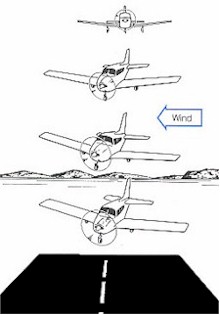
Forward Slip - Transport Canada photo

The other day I was out flying with my instructor reviewing soft field procedures. We were doing circuits on runway 25, and on the turn from the downwind to base leg of the circuit, we were  hit with strong turbulence every time.  The leg goes close to the river so we assumed it was something to do with that.  It was a bit much for me and I lost my concentration, so I kept coming in too high and fast.  After a few we landed and the controller immediately announced a runway change to runway 16.   I decided that I still wanted to try it, given that the circuits we did on 25 weren’t really that great.

After takeoff from runway 16 the turbulence hit us again only a few hundred feet AGL. I decided that it was probably best to ask for a full stop and end the lesson.  The turbulence was too distracting and kept me from being able to concentrate on the maneuver.  Inadvertently on the landing again, I came in too high.  So my instructor told me to use a forward slip – which is something that I’ve done numerous times – but I hesitated and my mind went blank.  I eventually did it, but think this is a procedure I need to practice still, particularly when I go solo.

What is a forward slip?

It is a turn that is prevented by use of rudder.  The airplane moves in straight, drag inducing position that increases rate of descent and doesn’t increase airspeed – because of all the drag that is created by the airplane in that configuration. The aileron holds the bank while the opposite rudder causes the nose to point in the other direction.

To enter a forward slip, power to idle, turn the aircraft into the wind, and use opposite full rudder. The configuration feels somewhat awkward to me since the airplane is steeply banked and pointing in the other direction. Like everything in flying, it is all about practice until it feels natural!

Another thing is I REALLY need to start bringing my camera and maybe my video camera to my flights! I am always too lazy to take photos but it is great to have them particularly so I can share them here.


Posted on

New Aviation Movie Review – Flight – Alaska Airlines Flight 261

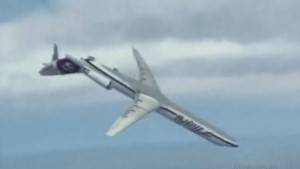
Alaska Airlines Flight 261

Flight is based on a real life incident involving Alaska Airlines Flight 261

I recently watched the new aviation – themed movie, Flight starring Denzel Washington.   In it, a troubled airline pilot experiences an in-flight emergency where the horizontal stabilizer jams in the down position, sending the jet into a deep nose dive. Because the captain is a maverick pilot, he is able to miraculously save 102 people through a daring maneuver.  However the accident also forces him to deal with some of his other demons with alcoholism and drug abuse.

I really enjoyed the movie and the rest of the weekend I spent thinking if the flight maneuver was aerodynamically possible.  Basically, he inverted the plane while it was in the steep dive, which managed to arrest the dive and allow him some semblance of control of the aircraft.   Given the stress that is associated with in-flight emergencies, it is doubtful that it could be done.  But is it completely impossible?

Forcing the aircraft into an inverted position when the elevator was down would theoretically cause the aircraft to want to pitch up instead of down. Though because the horizontal stabilizer is now inverted as well the effect would be much lessened. The control of the aircraft from the ailerons would be backwards, and lessened given the fact that the airflow is supposed to be on the top side of the wing and not bottom.  I’m not sure if it’s possible, but probably very aircraft specific.  It’s probably not impossible…but the fact that the airplane doesn’t immediately reassume the nose down position when rolled the right side up after flying upside down? Definitely not realistic. 

It is interesting to note that the accident in this movie is based on a real life incident involving Alaska Airlines in January 2000.

What happened on Alaska Airlines Flight 261.
What happened on Alaska Airlines Flight 261. Photo courtesy of iasa.com.au.

In this incident, the horizontal stabilizer jammed and the pilots attempted to fly the aircraft inverted – but they didn’t have enough altitude to recover.

In any case, it is a great movie – and I highly recommend it to anyone, particularly aviation enthusiasts like myself.  The figure below shows what happened on Alaska Airlines flight 261.

Looking to buy Flight DVD?

amzn_assoc_tracking_id = “flytime_ca-20”;
amzn_assoc_ad_mode = “manual”;
amzn_assoc_ad_type = “smart”;
amzn_assoc_marketplace = “amazon”;
amzn_assoc_region = “US”;
amzn_assoc_design = “enhanced_links”;
amzn_assoc_asins = “B00AF6B22E”;
amzn_assoc_placement = “adunit”;
amzn_assoc_linkid = “b24d3878a2d320b59ebd174a1295a0c4”;